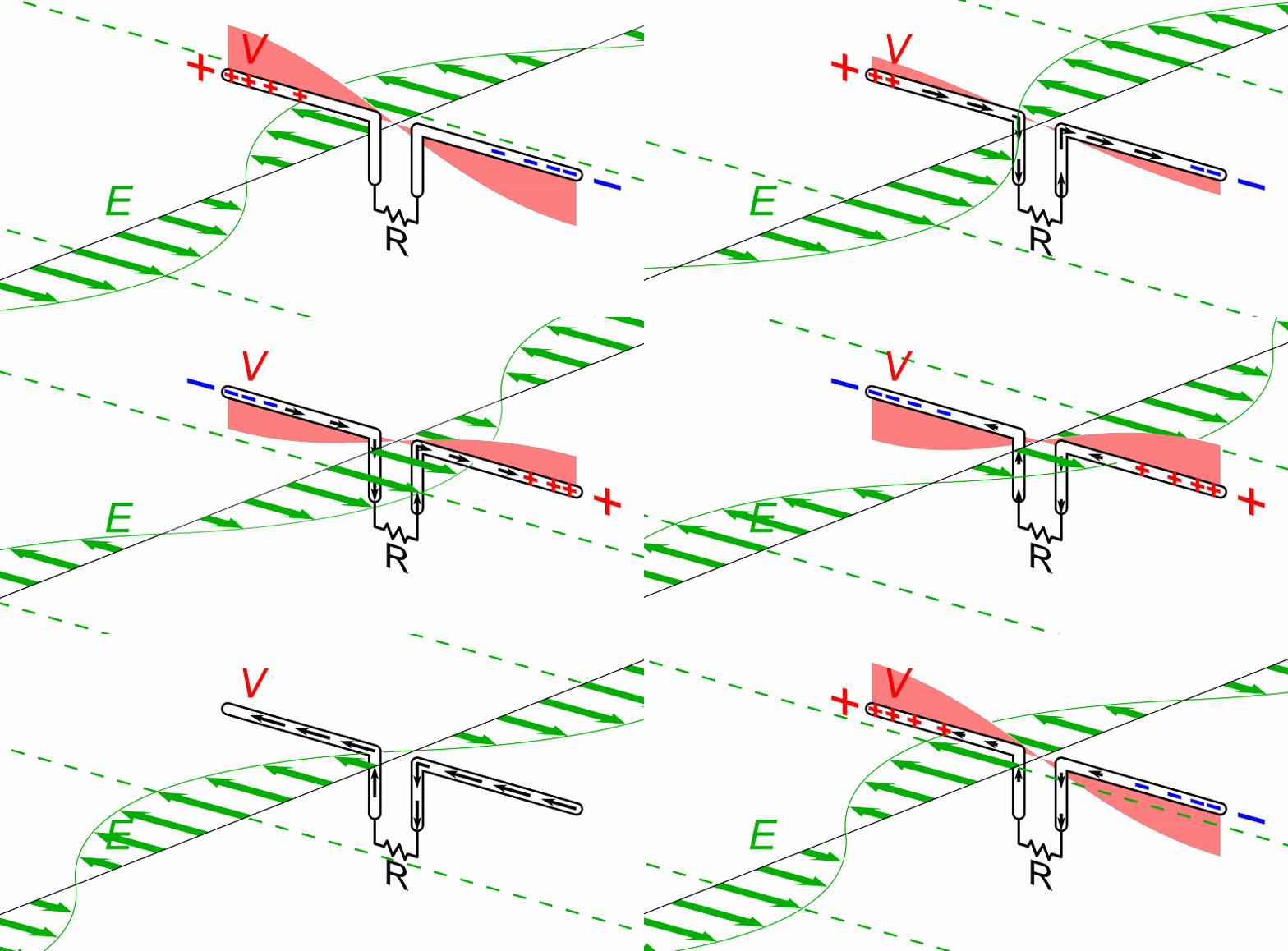
Two-Element Dipole
Thin-wire end-effect ~5% applied. Output uses your selected units only.
Choose options and click Calculate.
More: Feeding, matching & choking
- Center-fed (split) dipole prefers a 1:1 current balun at the feedpoint.
- If matching is needed, use an LC network or a tuner at the shack end (keep feedline losses low).
Ground-Plane (3 Radials @ 45°)
Radials default to ¼-wave (+~5%) at 45° for ~50–60 Ω.
Choose options and click Calculate.
More: Matching & choking
- 5/8-wave radiators often need a small series inductor to cancel capacitive reactance.
Yagi–Uda Array
Driven shortened ~5%. Reflector ≈ 1.05× driven; directors taper shorter. Spacing ~0.15–0.20 λ.
Choose options and click Calculate.
More: Feeding, matching & choking
- Split driven: 1:1 current balun at feed.
- Gamma/hairpin: still add a common-mode choke near feed.
- Folded dipole: ~300 Ω → 4:1 balun.
Parabolic Dish + Feed
Default 20 λ (~solid, good gain)
Dish D/f/d computed from F/D and diameter. Wavelength selection scales feed element example dimensions only. Feed sits on the concave/front side at the focus.
Choose options and click Calculate.
More: Feed choice, matching & choking
J-Pole Antenna
Radiator is fixed at ½-wave (~5% shorten). Stub is ¼-wave. Spacing ≈ 0.02 λ. Tap ≈ 0.06 λ above the short.
Choose options and click Calculate.
More: Tap, matching & choking
- Feed: center → stub; shield → radiator. Slide tap to fine-tune SWR.
- Short bar: connects stub bottom to radiator bottom.